Terminal GPT

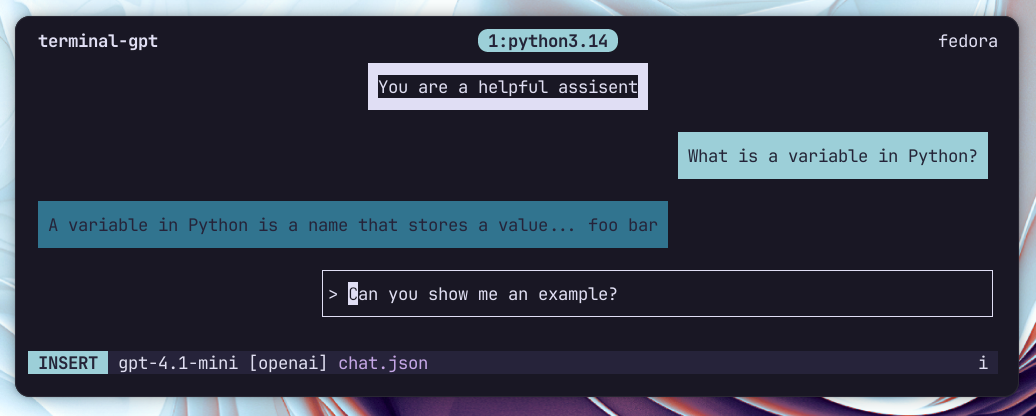
Terminal GPT From my usage of ChatGPT while working in the terminal I noticed a couple of things. Normally I have a simple question, need to copy part of the output, and go back to the terminal. For a keyboard-focused workflow, switching to the browser every few minutes gets tedious. So I set out to build something you can use without leaving the shell. Why I built it I like to edit the conversation history. If the model makes a small mistake in an earlier reply, I want to correct that message so follow-ups don’t keep repeating the same error. I also live in Vim, so I tried to port as many Vim-like keybindings into the app as possible. ...

February 23, 2026 · 4 min · Lukas Hofbauer
Consession logo

Consession

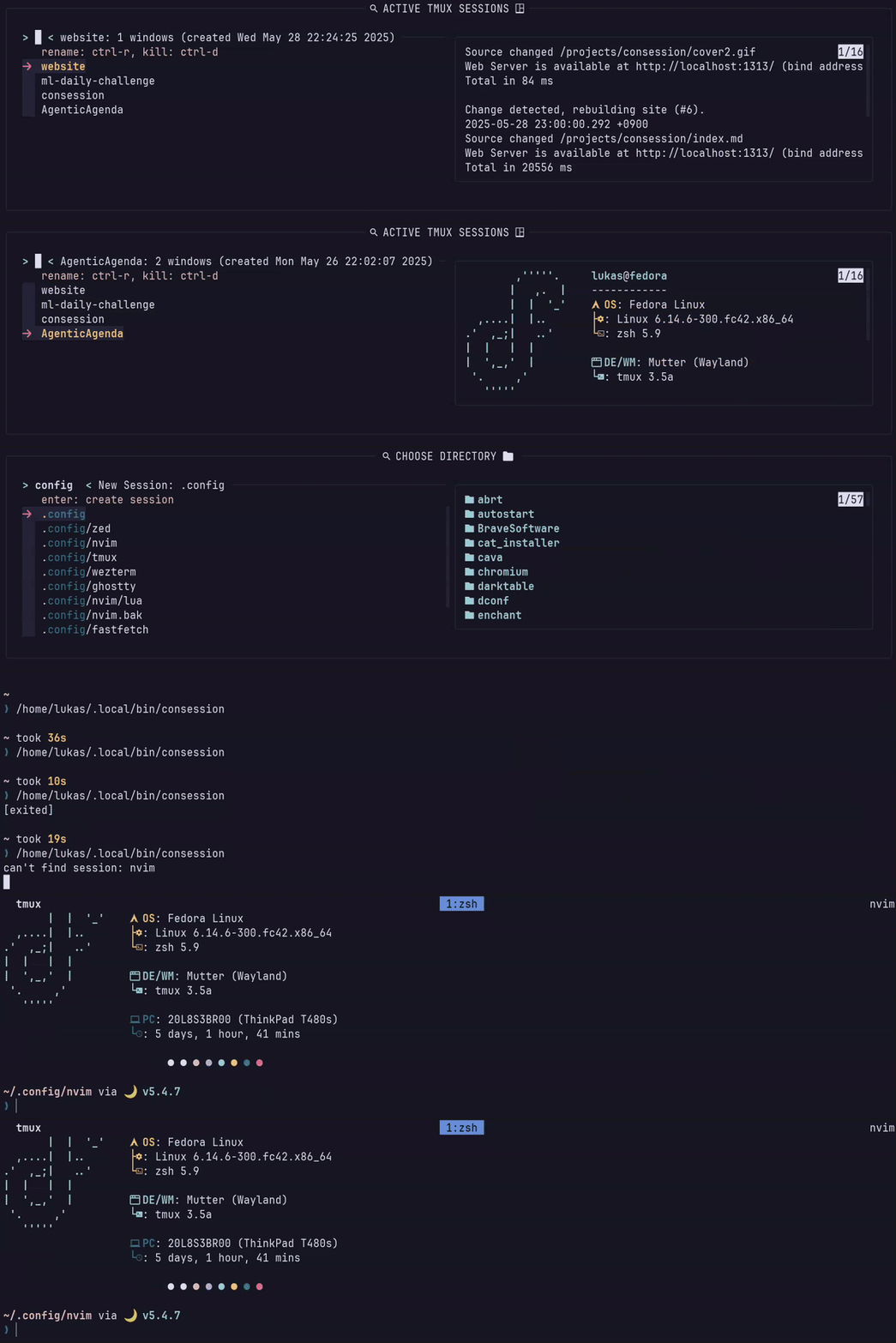
I love working in the terminal, there’s nothing quite like it. Once you’ve set up your workflow, navigating your system becomes second nature. Flying through the filesystem, quickly editing files, batch-moving specific file types, writing quick bash scripts, or chaining commands together with pipes — it’s all possible without ever lifting your hands from the keyboard. Learning to use the terminal effectively might be the highest ROI you can make as a developer. Every new tool you master becomes a force multiplier, letting you work faster and more efficiently. ...

April 22, 2025 · 2 min · Lukas Hofbauer
Spinning Cube in 3D

Spinning Cube: A Pure C Experiment in Graphics and Algorithms

Introduction Programming is all about problem-solving, and sometimes the best way to improve is by challenging yourself. In my latest side project, I set out to write a 3D spinning cube entirely in C—without looking anything up. No tutorials, no external help—just raw problem-solving and deep diving into low-level programming. This project, hosted on GitHub (itsfernn/spinning-cube), was an opportunity to practice my C skills, experiment with complex linear algebra, and implement convex hull algorithms in a self-contained, pure C environment. ...

March 1, 2025 · 2 min · Lukas Hofbauer

Alpenwort: An Interactive Website to Explore 150 Years of Alpine History

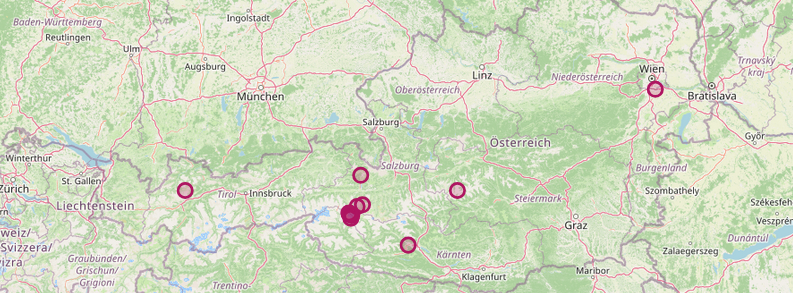
Introduction As part of a university project, I was asked to create a website for the Tyrolean Alpine Journal. The project required a variety of skills I have developed throughout my education so far. The original dataset was quite noisy, with errors introduced by OCR (image-to-text scanning), which made processing more challenging. Project Goals The main objectives of the project were: Extract location data from plain text Map that data to candidate geographic positions Use LLMs to resolve ambiguities (for example when multiple locations share the same name) Build an interactive website to explore the results Data Extraction and Processing For extracting locations, I used the well-established named entity recognition (NER) tool spaCy. From the extracted entities, I created a dataset and mapped each entry to candidate locations using the GeoNames API. ...

May 3, 2024 · 3 min · Lukas Hofbauer